Tag: Sands at Sossuviel

  • Day 6 Desert Lodge and Sossusvlei

    We are on the edge of the Namib/ Naukluft National Park. Just a huge expanse of sand, where an amazing amount of wildlife manages to exist.

    The Sossusvlei is an area of extraordinary beauty – red dunes blown in strange shapes by the constant wind.

    Our guides had explained the difficulty of climbing the famous dune 45 and the access to it, a 4km walk in sandy harsh conditions. Normally a 4km.walk would not phase me but there were 4WD vehicles available to cover this stretch, such is the difficulty of the trek.

    I felt I would enjoy being in Desert Lodge,a unique place for the day, rather than slogging up a sand dune. Although it was bordered by the desert, it had a swimming pool and a large bar with tables you could sit at to take advantage of the wifi. I spent a happy day observing the animals coming and going to the waterholes. Our accommodation was top class. It was newly-built chalets with verandahs facing the desert. The front part of the chalets had two beds, then a wall behind with openings on both sides, with access to the bathroom, toilet and clothes hanging space.

    My room mate, enjoying the peace of our environment.

    Eventually, the group returned. They were all exhausted and at least one of the group was ill from the heat. No one climbed dune 45.

    We were here from the end of October to mid November, which is moving towards high summer. The temperature reaches 50′ C in December and the rain starts to fall. We were witnessing Southern Africa at the end of a very dry spell. As we moved up towards Zimbabwe, we saw the first of the rains starting, but that was not for another two weeks.

    Our guides cooked us a delicious dinner. Next morning, I took a walk up the avenue- about a mile- so that I could loosen out my calf muscles which had begun to tighten up with all the sitting on the bus.

    I had a great view of some buffalo that had come to drink at the waterholes. amazing powers of survival. I felt myself amazed at how living things adapted to nature. Coming from a country where we have almost continuous rain, this seemed like a miracle to me. We were to spend another week in this extraordinary Country of Namibia, travelling next to the coast and the vast expanses of beaches that dwarf any coastline in Europe.

  • Day 5 Namib desert

    Day 5 Namib desert

    Quiver tree sculpture at Desert Lodge

    Our day started with a forgettable breakfast at the Seeheim. 

    We crossed the disused train tracks and we were buoyed up by Swise’s promise of the best Apple Pie in Namibia, in a town called Bethanie. 

    Our route on ‘gravel roads’- bumpy

    A German missionary called Schmelen tried his best here for a few years, in 1814, until he went home, discouraged by the lack of cooperation from the Red Nation tribes that lived in the area. The oldest building in the area is the church built by him.

    A historic agreement whereby Luderitz bought land from the local chief was signed at a house in Bethanie. He later sold it on, claiming he had bought a much larger piece of ground due to the difference in the definition of a German mile and a South African mile.

    The town of Luderitz on the west coast is called after him.

    Namibia was known as Namaland after the Nama people who live there. Its name was changed to German South West Africa when it was taken over by the Germans. It gained full independence in 1990, some very recent history.

    In any event, the apple pie was delicious and the surroundings – a beautifully tended garden with cacti, succulents and trees for shade, made it a pleasant stopover.

    On the road to our destination, we spotted a Pale Chanting Goshawk, doing what the bird book said he does – sitting on top of a telegraph pole.Ostriches were seen along the edge of the road. 

    Pale Chanting Goshawk

    We had our first glimpse of an antelope, however, as we settled into our chalets, right on the edge of the desert at the Desert Lodge.

    In front of the chalets was a watering hole, where Oryx had just returned after the winter. The first night, we saw only a single one. Next morning, I spotted six.

    Oryx or Gemsbok with three twists in his horns

    Some wildebeest or Gnu gathered further down the long sandy drive to the Desert Lodge.

    It was all about sand here. It builds up, blown by the desert winds that come up from the rapid cooling and heating of the air every night and day. The contrast was extreme and definitely made us understand how rocks would shatter with the differing temperatures.

    Every day, sand piles against the door, around the swimming pool, into machinery, the battle goes on with sweeping being a major task. 

    In the morning, I noticed hoof marks around the pool where animals had come for water the night before. We spotted wild dogs close by and we were warned to keep the zips on our bags closed at all times because of the number of scorpions.

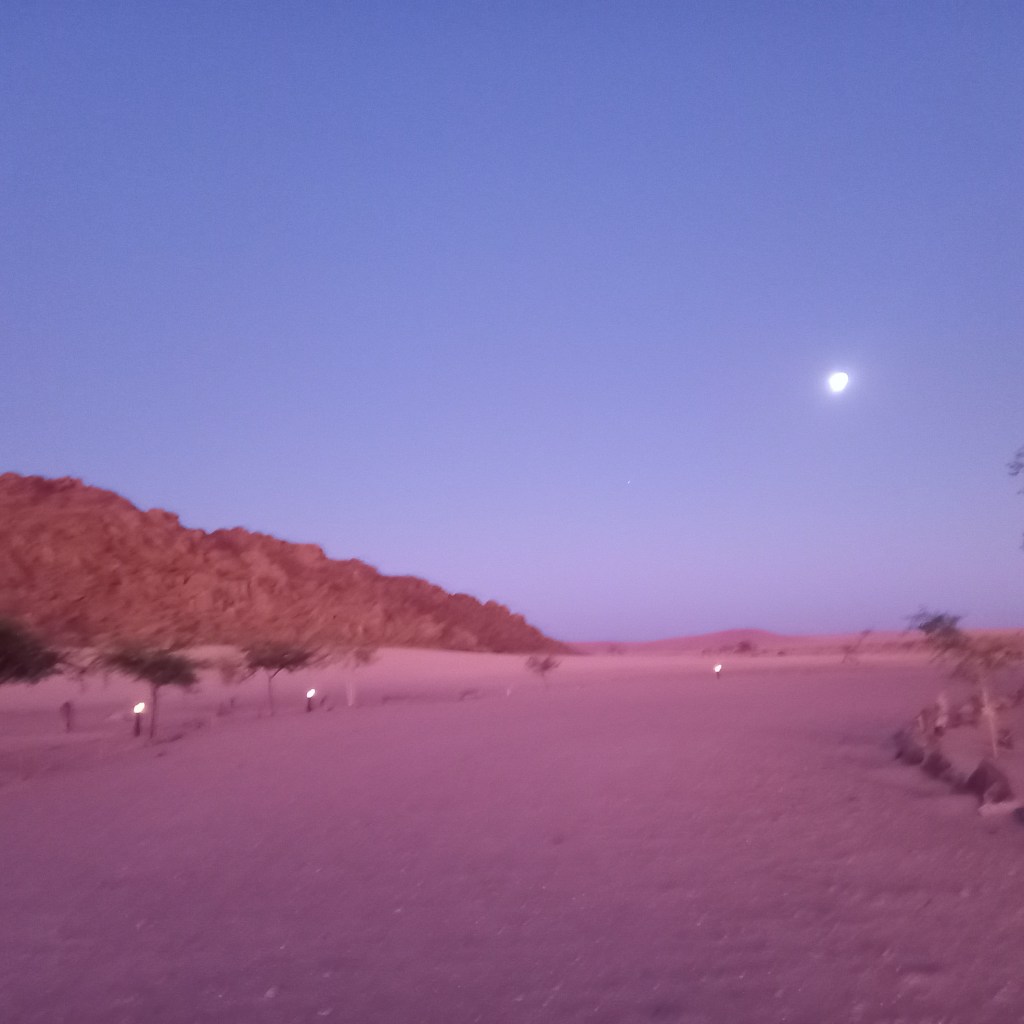
    Our guides made us dinner and we washed up and settled down for the night. Our accomodation was modern and comfortable. The sky was spectacular with the moon waning on the wrong side. In the southern Hemisphere, it wanes to the left. We saw little slivers coming off the left every night, so you could hold the moon in your right hand while it’s waning.

Is this your new site? Log in to activate admin features and dismiss this message
Log In