Category: Travel

  • Day 5 Namib desert

    Day 5 Namib desert

    Quiver tree sculpture at Desert Lodge

    Our day started with a forgettable breakfast at the Seeheim. 

    We crossed the disused train tracks and we were buoyed up by Swise’s promise of the best Apple Pie in Namibia, in a town called Bethanie. 

    Our route on ‘gravel roads’- bumpy

    A German missionary called Schmelen tried his best here for a few years, in 1814, until he went home, discouraged by the lack of cooperation from the Red Nation tribes that lived in the area. The oldest building in the area is the church built by him.

    A historic agreement whereby Luderitz bought land from the local chief was signed at a house in Bethanie. He later sold it on, claiming he had bought a much larger piece of ground due to the difference in the definition of a German mile and a South African mile.

    The town of Luderitz on the west coast is called after him.

    Namibia was known as Namaland after the Nama people who live there. Its name was changed to German South West Africa when it was taken over by the Germans. It gained full independence in 1990, some very recent history.

    In any event, the apple pie was delicious and the surroundings – a beautifully tended garden with cacti, succulents and trees for shade, made it a pleasant stopover.

    On the road to our destination, we spotted a Pale Chanting Goshawk, doing what the bird book said he does – sitting on top of a telegraph pole.Ostriches were seen along the edge of the road. 

    Pale Chanting Goshawk

    We had our first glimpse of an antelope, however, as we settled into our chalets, right on the edge of the desert at the Desert Lodge.

    In front of the chalets was a watering hole, where Oryx had just returned after the winter. The first night, we saw only a single one. Next morning, I spotted six.

    Oryx or Gemsbok with three twists in his horns

    Some wildebeest or Gnu gathered further down the long sandy drive to the Desert Lodge.

    It was all about sand here. It builds up, blown by the desert winds that come up from the rapid cooling and heating of the air every night and day. The contrast was extreme and definitely made us understand how rocks would shatter with the differing temperatures.

    Every day, sand piles against the door, around the swimming pool, into machinery, the battle goes on with sweeping being a major task. 

    In the morning, I noticed hoof marks around the pool where animals had come for water the night before. We spotted wild dogs close by and we were warned to keep the zips on our bags closed at all times because of the number of scorpions.

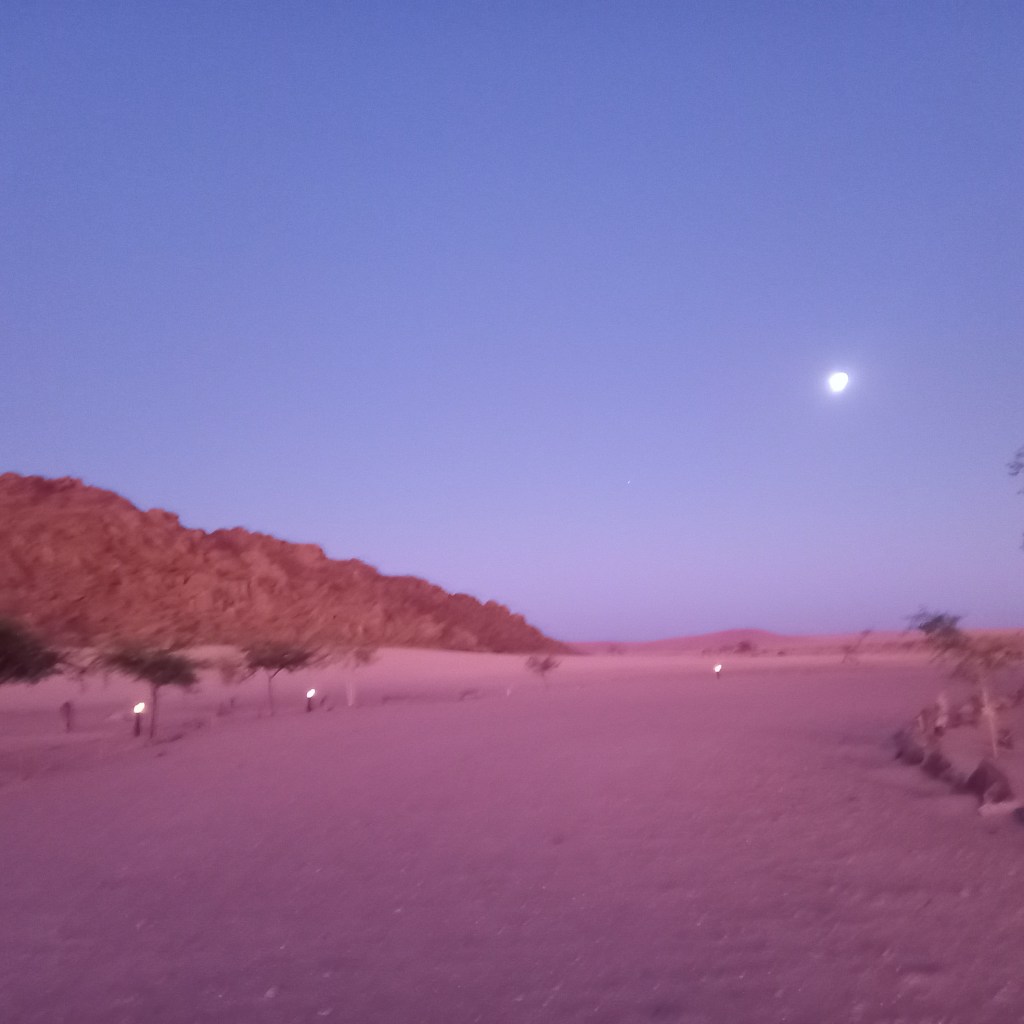
    Our guides made us dinner and we washed up and settled down for the night. Our accomodation was modern and comfortable. The sky was spectacular with the moon waning on the wrong side. In the southern Hemisphere, it wanes to the left. We saw little slivers coming off the left every night, so you could hold the moon in your right hand while it’s waning.

  • Day 4 Fish River Canyon

    Day 4 Fish River Canyon

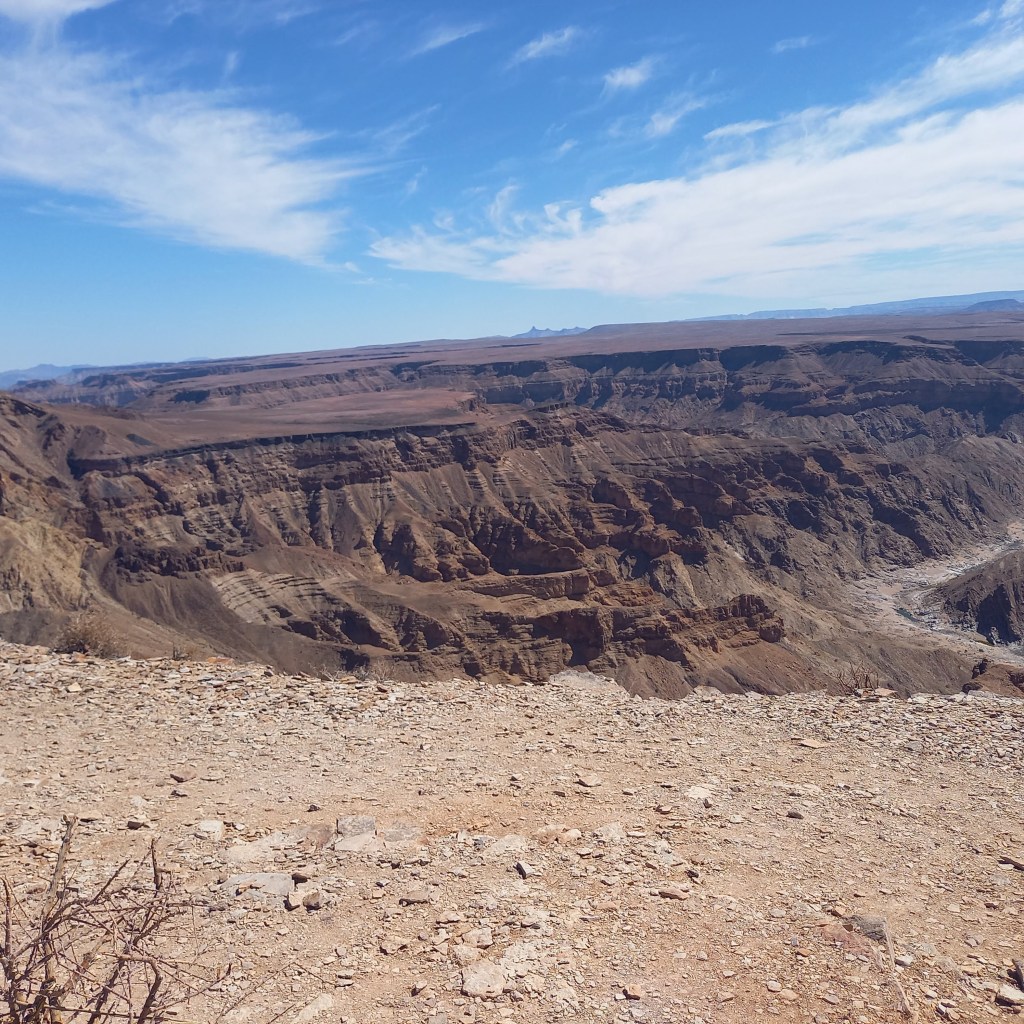
    Fish River Canyon

    Next morning, we opted to make a start for the Fish River Canyon early, rather than take two hours on a canoe trip.

    We had a delicious cooked breakfast, bacon, sausages and beans and we washed up, loaded the bus and set out North again, this time towards the real desert.

    As we drove over gravelled roads, our guide pointed out how people had made farms in the desert where there had been nothing before. We saw acres of date palms and tomatoes.

    What he also explained was that workers came to these remote places with no facilities and set up what are really shanty towns as the option of commuting is not available. Water has to be carried from a distance.

     We passed a large settlement where people had nothing more than shacks to live in.

    Again, I felt privileged and lucky to be driving past in a modern well equipped vehicle.

    The terrain became more desert-like and the road continued in its ‘gravel’ status, ie very bumpy.

    Plots of ground have been fenced off by buyers and whole hills are demarcated such as Mount Elena that we passed by.

    We stopped at a little outpost of Fish River Canyon and saw one of many Quiver trees we would see from now on. The San people used to hollow out the trunk and use them for quivers for their arrows, hence the name.

    The lower branches tend to be torn off by Kudus and Springbok. The leaves of the tree are equipped to withstand long periods of drought. 

    It’s been three years since they had any significant rainfall here and we had to imagine that there were rivers here in rainy season, as there were only puddles at the bottom of the canyon, which we drove to next.

    This is the second largest canyon in the world after the Grand Canyon in the USA.

    We spent some time marvelling at it and taking photos. 

    Inhabitants have been recorded here as far back as 70,000 years ago and some of the oldest Rock Art in the world can be found here.

    We drove on to our next accommodation, in an outpost known as Seeheim. I use the word outpost advisedly, as it is in the middle of a junction that no longer exists. Train tracks run through this desolate place, but it has been many years since the sound of a locomotive has been heard. Now, you can listen to the creaking of the abandoned wind generator as it turns lazily in the breeze. 

    We sat on the porch and imagined Charles Bronson playing his lonesome tune from ‘Once Upon a time in America’ on the other side of the tracks.

    There has been a hotel here since 1895 and it became an important stopover point when diamonds were discovered in Johannesburg. At one time a Brothel was started up, although it was tightly regulated, with concerns for the health of the  five women engaged there.

    Passengers from Luderitz on the coast headed for Johannesburg needed some entertainment while waiting for their connection onwards.

    At one time, it was a lemonade factory, set up by the hotel owner’s sister after the Second World War.

    It was rebuilt an indeterminate number of years ago, but it is fairly dilapidated, except for the bar and reception area which have an interesting array of long dead Ungulates.

    The Rugby World cup between SA and NZ was televised in the large dining room and some of us stayed up after dinner to watch that.

    After casting bets as to how many of us would survive the night, it being close to halloween, we said good night. On our way to our various rooms, we noticed a partial eclipse of the moon, which was full, another ominous sign….

  • Day 3 Gariep river

    Day 3 Gariep river

    View from hill behind chalets

    Felix Unite campsite.

    27th October 2023

    Day 3

    the day dawned gradually over the vinyards of Highlanders lodge.

    I made my way up to the swimming pool bar where Raul had coffee on the go at 6.30 am. 

    Pretty soon, the two Rhodesian Ridgebacks made their appearance, the younger one, Geoffrey with a tennis ball in his mouth, covered in slime and drool.

    I still threw it for him , he was so adorable.

    Soon, he was joined by his larger companion, Troy, same breed, but twice his size. They gambolled about( if that’s not a word reserved for lambs) while I attempted to drink the coffee in between it spilling everywhere as they bumped and nudged me to play.

    Breakfast was at 7.15  and the coconut yoghurt went well with fresh fruit, around the now extinguished campfire.

    Swise and Tawanda rallied us after the washing up was done and we left the Cederberg for new pastures. 

    We spent the day driving north, punctuated by loo breaks (bushie bushie) and a longer one for lunch.

    Terrain becoming desert-like
    Stops along the way
    Stretching our legs

    One of these breaks was in Springbok- formerly famed for the amount of these beasts that inhabited the area before man came along and killed off so many of them. I was fascinated that the rugby team actually had a place. The Springbok is the emblem of South Africa.

    We were still in Northern Cape, the largest of the nine provinces in South Africa.

    We kept going until we got to the border to leave SA. We had to produce our passports to the police who stamped them and gave them back to us, thankfully.

    On a few miles and out again, this time to enter Namibia.

    We had to fill in forms individually and another stamp was applied to our passports.

    When I got back to the bus, I read my Irish passport for the first time ever. It is full of patriotic phrases and welcoming sentiments towards immigrating people. It has images of ancient and modern Ireland embossed on it that are very impressive.

    ‘The harp that once through Tara’s Halls’

    We crossed the Orange River, now known by its original name, Gariep River,  and were officially in Namibia. It was formerly German South West Africa and gained independent statehood finally in 1990.

    Felix Unite, our accomodation for tonight was only a 10 minute drive.

    The chalets are set looking over the Orange river, as it swirls and eddies along. We can see where it had flooded, leaving reeds and grasses on the higher ground.

    There is a manicured lawn in front of our chalet with outside chairs and a table.

    At last a chance to break open the bottle of red from Robertson winery that I bought 2 days ago – or was it yesterday? – the days are melding into each other.

    Dinner will be at 1845 and river canoeing awaits us tomorrow.

Is this your new site? Log in to activate admin features and dismiss this message
Log In